
Mecosta County Criminal Court Cases
Mecosta County criminal court cases use a two-court path. The 77th District Court hears misdemeanors punishable by no more than one year. It also handles the start of a felony case, including the complaint and warrant, arraignment, bond, probable-cause conference, and preliminary examination. If a felony is bound over, meaning transferred after the preliminary stage, the 49th Circuit Court becomes the trial and sentencing court. High-court misdemeanors may also proceed in Circuit Court like felonies.
The clerk keeps the official Mecosta County court case file. The District file can show the early felony events, while the Circuit file shows the information, later pleas or trial, judgment, and sentence. A District result that ends at bindover is not necessarily a closed matter. Search the Circuit index next. City and campus arrests also route into these county courts rather than a separate municipal criminal court.
Mecosta County MiCOURT Search Doors
MiCOURT's C49 search is the public index for 49th Circuit Court cases. The official search screen below shows why choosing the right court is part of the lookup rather than a mere filter.
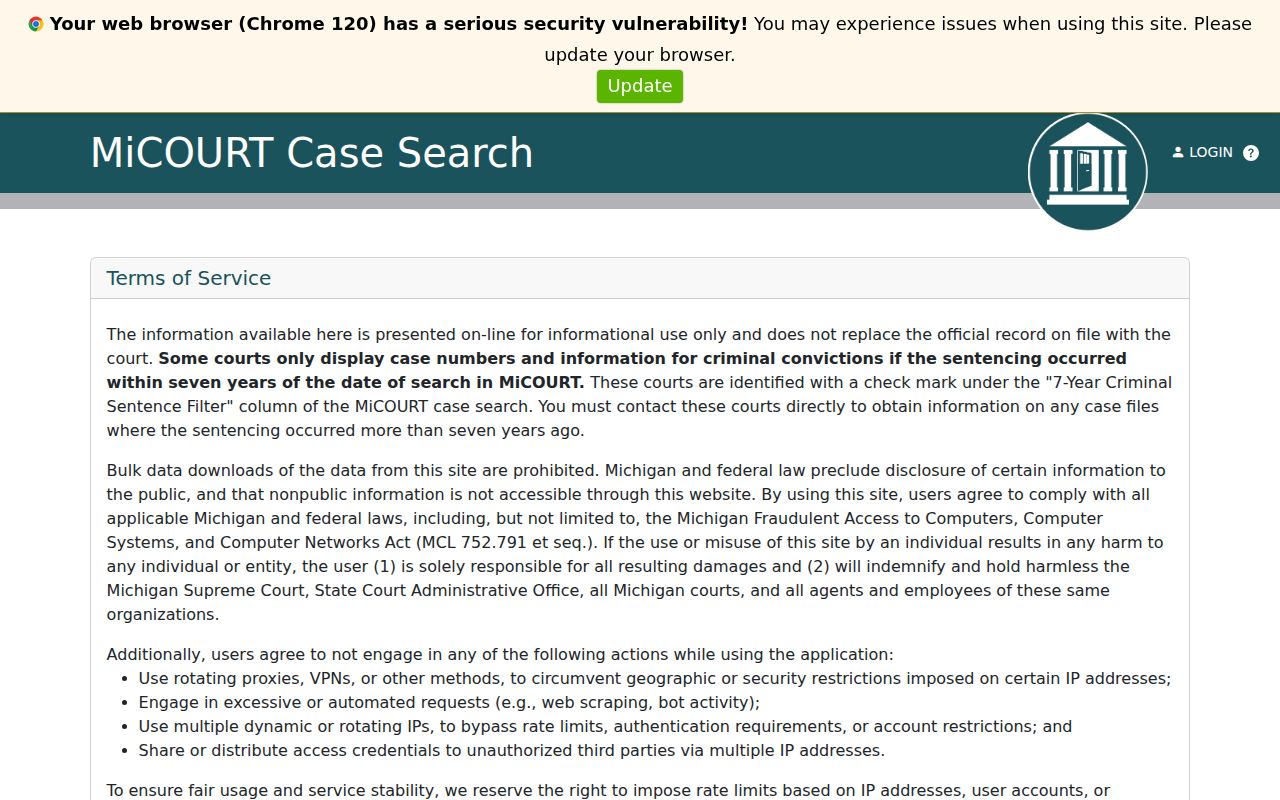
The C49 view is the place to continue a felony after bindover and to locate the Circuit case number, public events, disposition, and sentence entries.
MiCOURT's D77 search is a separate door for 77th District Court. Its official form uses the same basic name or case-number approach but searches a different docket.
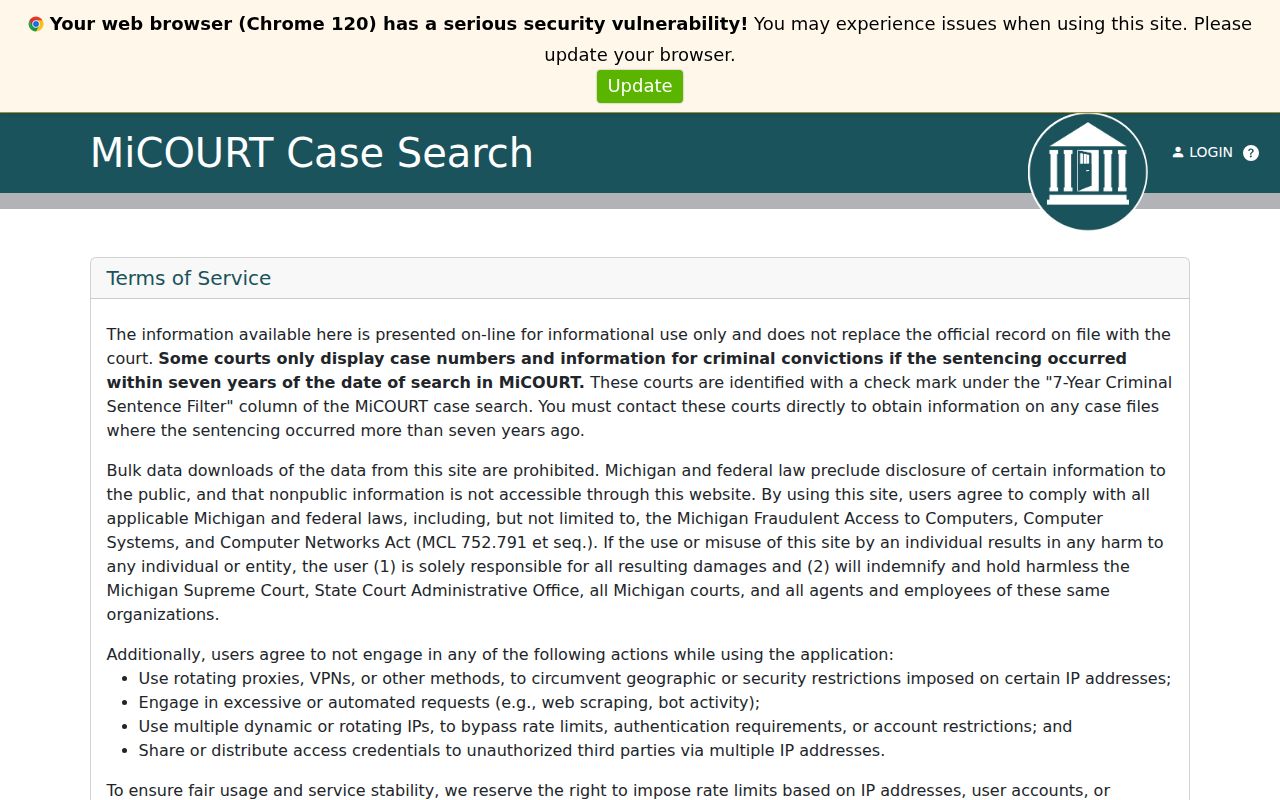
The D77 screen serves misdemeanor cases and the first stages of felony matters. Checking both court codes prevents a transferred felony from looking as if it simply stopped.
Searching Mecosta County Case Records
Start with the court that matches the known stage. A case number is the cleanest key, but a participant-name search can locate a file when the number is unknown. MiCOURT is informational. It does not replace the clerk's official Mecosta County criminal case record, and public document images are not assured.
- Open the county Courts page or the direct C49 and D77 MiCOURT links.
- Choose D77 for a misdemeanor, arraignment, bond, or preliminary felony event. Choose C49 for a felony after bindover.
- Search by first and last name when no case number is known, using a date of birth only where the interface allows it.
- Open the matching docket and read the charge, event, and disposition lines in date order.
- Call or visit the correct clerk for certified copies, archived matters, missing images, or an unclear result.
The public forms expose a small, useful set of inputs. Do not assume partial-name behavior or treat a broad match as confirmed identity.
| Field Label | Type | Required | Notes |
|---|---|---|---|
| Court | Selected context | Yes | Use C49 or D77 |
| Search Type | Tab or radio | Yes | Name or Case Number |
| Last Name/Business Name | Text | Name mode | Partial matching should not be assumed |
| First Name | Text | Not stated | Narrows a person search |
| Date of Birth | Date or text | Not stated | Use when known; display may be limited |
| Case Number | Text | Case mode | Enter the local displayed format |
| Search | Button | Yes | Submits the selected query |
| Clear/Reset | Button | No | Clears criteria where displayed |
Note: A name match is a lead, not fingerprint confirmation; compare the court, case number, charge history, and public identifiers before relying on it.
Older Mecosta County Case Records
MiCOURT warns that some participating courts display criminal conviction information only when sentencing occurred within seven years of the search. That is an online display limit, not a rule that destroys older Mecosta County criminal court files. A no-result may also reflect a nonpublic case, a set-aside, a sealed order, different name data, or a file that requires clerk research.
For an older misdemeanor or an early felony file, contact the District criminal counter. For a bound-over felony or high-court matter, contact Circuit Court or the County Clerk route. Ask about the exact case number, archive retrieval, copies, certification, and any available electronic media. The reviewed county material does not publish criminal-file copy or certification prices, so get a current quote before placing an order.
Note: The seven-year warning describes some online displays; it does not set a destruction date for the official Mecosta County court file.
Inside a Mecosta County Case File
A public case entry is a map of the proceedings. It may name the court, filing date, case status, judge, public parties, charges, hearing dates, attorneys, bond activity, disposition, sentence, probation events, and public financial entries. The register of actions is the dated event list. It can point to important filings, but the online view does not promise that each underlying document can be downloaded.
| Case Number & Court | Identifies D77 or C49, the year, and the local file. |
|---|---|
| Charging Document | A complaint often starts the District matter; an information charges a bound-over felony in Circuit Court. |
| Docket Entries | The chronological register lists filings, hearings, pleas, rulings, warrants, and closure events. |
| Hearing Dates | Shows scheduled or completed events and may identify the judge or courtroom. |
| Disposition & Judgment | Records the result for each charge, such as dismissal, acquittal, or conviction. |
| Sentence & Conditions | May list custody, probation, fines, costs, restitution, and public balances. |
Full birth dates, government identifiers, victim and minor information, and sealed material are withheld. One Mecosta County case can contain different outcomes for different counts, so read each charge row rather than relying only on the overall status.
Reading Mecosta County Case Outcomes
Several plain terms prevent common mistakes. A dismissal ends a charge without a conviction on that count. An acquittal is a not-guilty result after trial. A conviction follows a guilty plea, guilty verdict, or another adjudication recognized by law. A disposition is simply the outcome. It must be read at the charge level because an amended case may contain both dismissed and convicted counts.
- Bindover
- The transfer of a felony from District Court to Circuit Court after the preliminary stage.
- Information
- The felony charging document filed in Circuit Court after bindover or waiver.
- Register of actions
- The dated list of events in the court file.
- Deferred status
- A result governed by a specific statute that may change public visibility after successful completion.
Attempt labels need extra care. MiCOURT warns that an attempt under MCL 750.92 may display as “FELONY” even when Michigan law treats that attempt as a misdemeanor. The letter “A” can identify an attempt. Check the precise statute and the signed judgment rather than drawing a conclusion from the portal label alone.
Note: A portal offense label can mislead; use the cited statute and signed judgment to classify the charge and final result.
How a Criminal Case Moves
A typical felony starts in 77th District Court, then moves to 49th Circuit Court only if it is bound over. The prosecutor's filed charge may differ from the allegation recorded at arrest. Motions, plea talks, or trial then shape the final outcome. A misdemeanor usually stays in District Court through trial and sentence.
Case flow: Charges Filed › Arraignment › Pretrial › Plea or Trial › Disposition › Sentencing
The court file is therefore distinct from the police narrative and booking record. To examine the custody event that came before filing, use the separate Mecosta County arrest lookup channels. The criminal court case shows what prosecutors filed and what the judge ultimately did.
Mecosta County Criminal Court Counters
Both criminal court counters are in the Mecosta County Building at 400 Elm Street in Big Rapids. This makes it possible to verify a District case and follow a bound-over file to Circuit without changing the main street address. The rooms, lines, and hours differ, so direct the request to the court that owns the stage of the file.
77th District Court
Room 118
400 Elm Street
Big Rapids, MI 49307
Criminal/traffic: 231-592-0794
Monday-Friday, 8:30 a.m.-4:30 p.m.
49th Circuit Court
Room 105
400 Elm Street
Big Rapids, MI 49307
231-592-0780
Monday-Friday, 8:30 a.m.-5:00 p.m.
Electronic devices must be off before courtroom entry and may be used only with the assigned judge's permission. Those are courtroom rules. Ask the counter before photographing or recording any public material.
Case Record Access & Restrictions
Michigan Court Rule 8.119(H) generally permits inspection and copying of a public case record unless a statute, rule, or sealing order restricts it. Court files are not requested from the clerk under Michigan FOIA because the judiciary is outside FOIA's public-body definition. Police and jail records, by contrast, remain with the executive agency that created them.
Juvenile matters, sealed or nonpublic cases, victim and minor details, full dates of birth, and protected government identifiers do not belong in the ordinary public view. A set-aside also removes a qualifying conviction from public availability while MSP retains a nonpublic record for limited authorized uses. When an expected file is missing, ask the clerk whether the issue is an archive, court transfer, restricted status, or name mismatch.
Note: Ask the clerk whether a missing file is archived or nonpublic before treating an empty search as proof that no case exists.
Federal Court Records Beyond Mecosta County
Mecosta County is in the Western District of Michigan, so a federal charge will not appear as a county C49 or D77 prosecution. The official PACER federal records gateway provides docket sheets and available filed documents, subject to account, fee, sealing, and redaction rules.
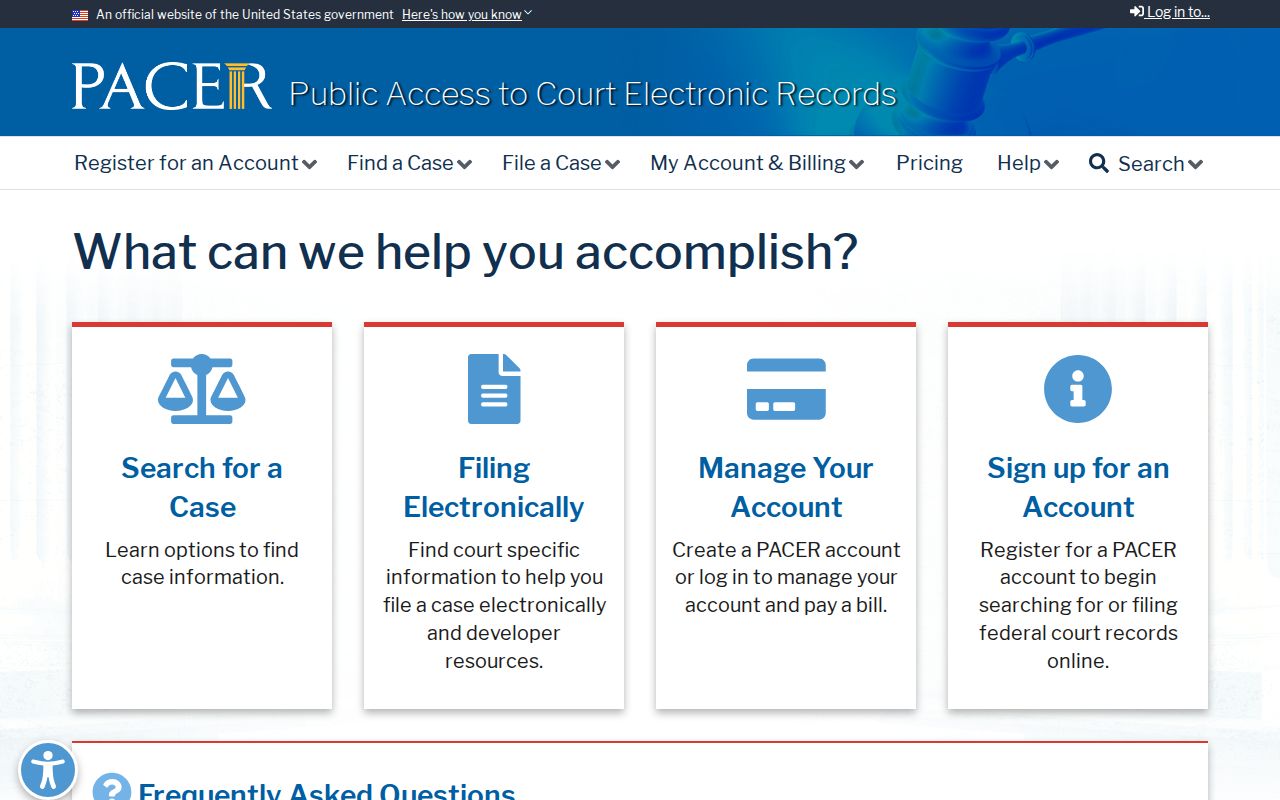
The PACER screen marks a separate federal layer. Use it only when the matter belongs to U.S. District Court, then confirm sealed items or official copies with the federal clerk.
PACER registration is required. As of the research date, many pages cost $0.10 each, many case-specific documents or reports have a $3 cap, and quarterly charges of $30 or less are waived. Name-search reports and transcripts can follow different cap rules. Public courthouse terminals allow free viewing, though printing may cost money.